2025 BYD Seagull Vitality Edition 305km EV (75 HP) – 12,000 km, Beige over Blue
Basic Parameters
- Stock No. SEAGULL-2025-VIT-001
- Year 2025
- Mileage (km) 12000 km
- Transmission Automatic
- Fuel Type Electric
- Engine (L / kWh) 30.08
- Displacement (cc) -1 cc
- Power (HP) 75 HP
- Drivetrain FWD
- Exterior Color Beige
- Interior Color Blue
- Seats 4
- Doors 5
- Origin (China port) Hefei
- Available Shipping To Global
Description
The short answer: this 2025 BYD Seagull Vitality Edition has 12,000 km on the odometer, the 30.08 kWh Blade battery, and 305 km of CLTC range. It is a 2026 plate car in beige with a blue interior, listed in Hefei, Anhui, and we can load it at Shanghai port on FOB terms. Domestic reference price is CNY 50,000, which works out to roughly USD 8,500 FOB Shanghai once land freight and export paperwork are included.
The Seagull is the cheapest way into a car with BYD’s actual battery chemistry behind it. Not a conversion, not a grey-import kit car — a factory-built five-door hatchback designed from scratch as an EV, built by the company that sells more electric cars than anyone else on the planet. That matters more than the badge for a first-time importer, because spare parts, diagnostic tools and battery knowledge are all widely available instead of being a research project.
What exactly is the 2025 BYD Seagull Vitality Edition?
It is the entry trim of BYD’s A00-class electric hatchback, sold in some markets as the Dolphin Mini. The Vitality Edition sits below the Freedom and Flying editions, so you get the same drivetrain and battery but a shorter equipment list: no rotating central screen on some builds, manual air conditioning, simpler wheel covers. What you do not get less of is the safety shell or the battery pack, which is where the money actually is.
Physically it is small. 3,780 mm long, 1,715 mm wide, 1,540 mm tall, on a 2,500 mm wheelbase. Four proper seats, five doors, and a boot that swallows a week of shopping or two cabin bags. It parks in spaces that a Corolla has to skip.
How much does this used BYD Seagull cost to export?
The domestic reference price for this car in China is CNY 50,000. Converted at roughly 7.2 to the dollar that is about USD 6,950. Add inland transport from Hefei to Shanghai, export declaration, and our handling, and the FOB Shanghai figure lands around USD 8,500.
From Shanghai the cost depends entirely on where it goes. A 40HQ container shared with two or three other small cars to a Southeast Asian port typically adds USD 900–1,400 per unit. Ro-Ro to the Middle East runs higher. Landlocked destinations in Central Asia are cheapest by rail through Khorgos. We quote CIF or CFR on request once we know the port.
Two things affect the final number. First, HS code classification — most countries put used BEVs under a different duty line than new ones, and some have preferential rates for vehicles over a certain age. Second, local homologation. The Seagull is left-hand drive and Chinese-market spec, so countries that accept Chinese CCC-based paperwork are straightforward; markets that demand EU WVTA or full local type approval need a conversation before you commit.
Is 305 km of range realistic in daily use?
No, and anyone telling you otherwise is selling. 305 km is the CLTC figure, and CLTC is the most optimistic cycle in common use — it runs at low average speeds with almost no climate control load. Expect 230–260 km of real mixed driving in mild weather, and closer to 180–200 km in a hot climate with the air conditioning running hard, or in winter below freezing.
That is still a genuinely useful car. For a city taxi fleet, a delivery run inside a metro area, or a household second vehicle doing 40–60 km a day, it charges overnight at home or at a depot and never touches a public charger. Where it falls apart is intercity work: 200 km of real range means you stop every 90 minutes on a highway run, and DC fast charging on this car peaks modestly.
Charging specifics: AC charging is 6.6 kW, so a full charge from low takes about five hours on a home wallbox. DC fast charging takes the pack from 30% to 80% in roughly 30 minutes. The port is GB/T, Chinese standard — buyers in Europe or the Middle East will need a GB/T to Type 2 adapter or a replacement inlet, budget for it.
What does 55 kW and 135 N·m feel like on the road?
Faster than the number suggests, because electric torque arrives at zero rpm. 55 kW is 75 hp, and in a car that weighs around 1,160 kg that is enough to be first away from a traffic light without drama. Top speed is limited to 130 km/h, which is fine everywhere except German autobahns and a few Gulf highways.
The honest limits: overtaking at 100 km/h needs planning, four adults plus luggage noticeably blunts acceleration, and long uphill grades at highway speed will pull the pack down faster than flat ground. Front-wheel drive only, no AWD option ever existed on this platform. Suspension is simple — MacPherson struts up front, torsion beam at the rear — tuned soft for city roads, which means it rolls a bit if you push it through a roundabout.
What is the interior actually like?
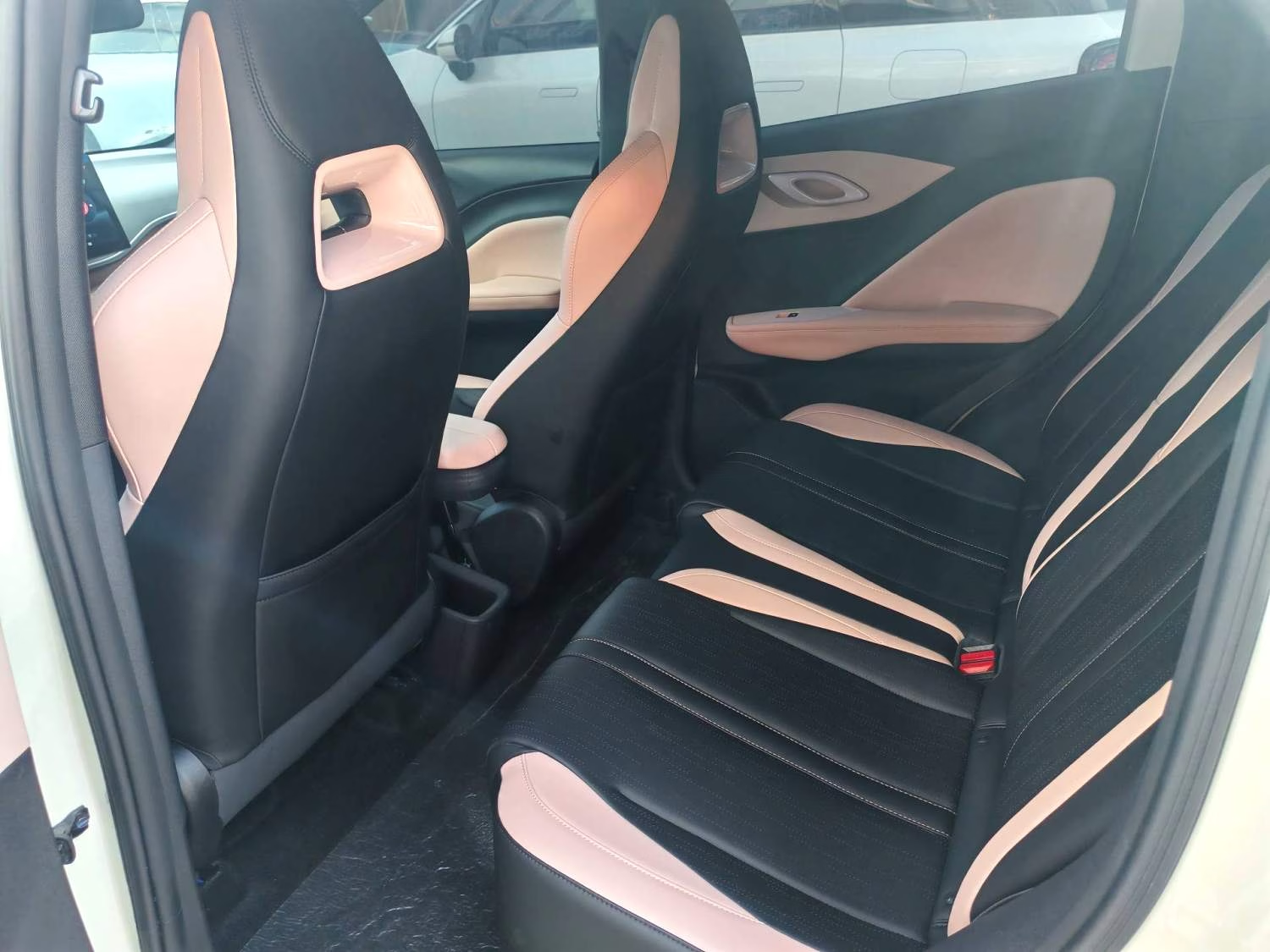
This particular car is beige outside with a blue interior, which is the more interesting of the two factory colourways. The blue is on the seats, door card inserts and dash trim; the rest of the cabin is dark grey plastic with a few hard-touch surfaces where you would expect them at this price point.
Seats are integrated-headrest buckets up front with a matching rear bench, fabric rather than leather on the Vitality trim. Door panels carry the same colour accent. Everything reads as designed rather than assembled from whatever was in the parts bin, which is the thing Chinese budget cars get right now and European ones mostly do not. Rear legroom is tighter than the exterior suggests — fine for two adults on a short trip, unpleasant for three.
What should an importer check before paying?
At 12,000 km this is essentially a new car, but the checks still matter because a Seagull that has been used hard as a ride-hailing vehicle looks identical to one that has not.
- Battery SOH report. Ask for a BMS scan showing state of health. Under 12,000 km a healthy pack should read above 96%. Anything in the low 90s means DC fast charging every day.
- Charging history. A car that was DC-charged daily degrades differently from one that was wall-charged overnight. Hard to verify directly, but it correlates with the SOH number.
- Registration document. Confirm the first-registration date matches the 2026 plate claim, and check whether it was registered to a company or an individual — fleet cars are more likely to have been worked hard.
- Accident and paint check. Small cars in dense Chinese traffic get touched. A paint depth gauge across the panels takes ten minutes and settles it.
- GB/T charging kit. Decide up front whether you need the Type 2 adapter bundled at purchase. Buying it locally after the car lands is usually more expensive.
Who is this car for, and who should skip it?
It fits fleet buyers in Southeast Asia and Latin America who need cheap, reliable urban EVs and can handle GB/T charging, and it fits private buyers in markets where a new Seagull costs two or three times what this one does landed. It also fits anyone who wants a first import with a low risk profile — a 12,000 km car from a manufacturer with published battery chemistry is a much easier conversation with customs and with a local mechanic than a rare model.
Skip it if you need motorway range, if your market demands EU type approval paperwork you cannot obtain, if you want fast DC charging at 100 kW or above, or if you regularly carry four adults. Nobody should buy a Seagull expecting a Golf. It is a small, honest city car that happens to be electric, and priced accordingly.
How does shipping from Shanghai work?
The car sits in Hefei, about 400 km inland from Shanghai. We move it by truck to the port, clear export declaration, and load either in a container (with two or three other Seagull-class cars for better per-unit rates) or on Ro-Ro depending on the destination line. Loading to sailing is usually 5–10 days from order confirmation.
Documents provided: invoice, packing list, bill of lading, certificate of origin, and the Chinese registration and deregistration paperwork needed for import in most jurisdictions. We do not sell cars we have not physically seen and photographed, and the photos in this listing are the actual car.
Key Takeaways
- 2025 BYD Seagull Vitality Edition, 2026 plate, 12,000 km, beige over blue.
- 30.08 kWh Blade LFP pack, 305 km CLTC (real-world 230–260 km), 55 kW / 75 hp, FWD, four seats.
- Domestic reference CNY 50,000; roughly USD 8,500 FOB Shanghai including inland freight and export docs.
- GB/T charging only — budget for a Type 2 adapter in Europe, Middle East or Latin America.
- Demand a BMS state-of-health report before payment; under 12,000 km it should read above 96%.
Want the full photo set, the SOH report or a CIF quote to your port? Browse our other BYD stock or send us the destination port and we will price it the same day.
Contact Us About This Vehicle
Reach out via your preferred channel — we reply within 24 hours.

Scan to add us on WeChat
WeChat ID: le-tian-chou
You May Also Like

2024 BYD Destroyer 05 Honor Edition 55KM Luxury (180HP FWD) Plug-in Hybrid Sedan
- 2024
- 53,000 km
- Automatic
- Plug-in Hybrid

2024 BYD Yuan UP (Atto 2) 401km Huoli Edition (95HP FWD / 22k km) Compact EV SUV
- 2024
- 22,000 km
- Automatic
- Electric

2025 BYD Song L DM-i 160km Transcendent Edition (DM 5.0 / 218HP FWD / DiPilot ADAS) Hybrid SUV
- 2025
- 2,000 km
- Automatic
2021 BYD Tang DM-i 112KM Premium Edition for Sale – 218 hp PHEV SUV, 7-Seater, Export Ready
- 2022
- 38,000 km
- Automatic
- Plug-in Hybrid
Related News

Cheapest Used Electric Cars for Sale: Where the Price Floor Sits
Used Tesla for Sale in New Jersey: What $25,000 Buys in 2026