









Used Electric Cars for Sale: How to Read a China Listings Page

Used electric cars for sale on Chinese platforms quote CLTC range, which is 20-30% optimistic versus real driving, and trim names that change every model year. Reading a listing properly means ignoring the headline numbers and checking four specific fields: pack size, charge cycles, registration type and battery chemistry.
Most overseas buyers lose money not because the car is bad but because they misread the specification. The gap between a “510 km” Atto 3 and the one you actually receive is a documentation problem, not a mechanical one.
Why is CLTC range so far off real range?
CLTC is a Chinese test cycle run at an average of 28.5 km/h with air conditioning off and a gentle acceleration profile. It was designed for Chinese urban traffic and it flatters every car. A 2023 XPeng G6 755 Long Range Pro claims 755 km. Owners report 520-560 km in mixed driving and about 430 km at a steady 120 km/h.
Use a 0.72 multiplier for city-heavy use and 0.57 for highway use. Those are not official numbers, they are what the owner forums converge on across BYD, XPeng and Leapmotor packs.
What do the trim names actually mean?
Chinese trims are marketing layers, not spec tiers. “Flagship”, “Beyond”, “Champion”, “Youth”, “Enjoy” and “Comfort” tell you almost nothing on their own. The 2022 BYD Yuan PLUS (Atto 3) 510km Flagship and the 2023 Atto 3 Champion Edition 430km Beyond are the same body with different packs. “Champion” sounds higher; it is actually the smaller battery.
Always price a car by kWh, motor output and wheel size. Everything else is upholstery.
Which listing fields should you verify independently?
- Pack capacity in kWh: the single most important number. 45 kWh and 60 kWh cars differ by $3,000+ on the used market.
- Registration type (使用性质): “非营运” is private, “营运” is commercial — commercial cars have hard mileage caps and heavy charge cycles.
- Transfer count (过户次数): more than two transfers on a three-year-old car means it has been flipped.
- Battery chemistry: LFP ages better than NMC in this price range. Both BYD and Leapmotor publish it.
- Charging port count: some base trims in the microcar class ship without DC. Confirm, do not assume.
How do you tell a good listing from a bad one?
Good listings include the VIN, the app screenshot with mileage, and a photo of the battery health screen. Bad listings have one studio photo, no VIN, and a price 20% below market. In the Chinese market a car priced 20% under comparable stock is usually a mortgaged title or a repaired write-off.
A 2024 Leapmotor T03 403 Comfort at $7,500 when the market says $10,000 is not a deal. It is a signal.
Does model year matter more than mileage?
On Chinese EVs, yes. The 2022-2024 window brought meaningful jumps in pack chemistry, thermal management and DC charging rates. A 2023 car with 60,000 km is often the better buy than a 2021 car with 25,000 km, because the newer platform will still be supported by software and parts in 2030.
Exception: the microcar class, where the platform barely changed between 2021 and 2024. There, mileage does the talking.
What is the fastest way to compare two listings?
Write down four numbers per car: battery kWh, real-world range at 0.72 × CLTC, motor hp, and price. Then divide price by usable range in km to get cost per kilometre of range. It sounds crude. It works better than any trim comparison table.
Two 2025 cars, for example: a Geely Geome Xingyuan 310km Youth at $9,000 gives 223 km usable, or $40 per usable km. A 2024 Leapmotor T03 at $10,500 gives 290 km usable, or $36 per usable km. The T03 wins on that metric — and loses on boot space, which is the trade you have to decide on yourself.
Key Takeaways
- Multiply CLTC range by 0.72 for city use and 0.57 for highway use to get a realistic figure.
- Trim names like Flagship and Champion do not indicate a bigger battery — check kWh directly.
- Verify registration type, transfer count and charge cycles; commercial-use cars carry heavy wear.
- A price 20% under market almost always means a mortgaged title or repaired write-off.
- Compare cars by cost per usable kilometre of range, not by price alone.
Related Vehicles

2022 BYD Yuan PLUS (Atto 3) 510km Flagship (204HP FWD) Electric Compact SUV
- 2022
- 56,000 km
- Automatic
- Electric

2023 XPENG G6 755 Long Range Pro (218kW / 296HP / 800V SiC) Electric Coupe SUV
- 2024
- 59,000 km
- Automatic
- Electric
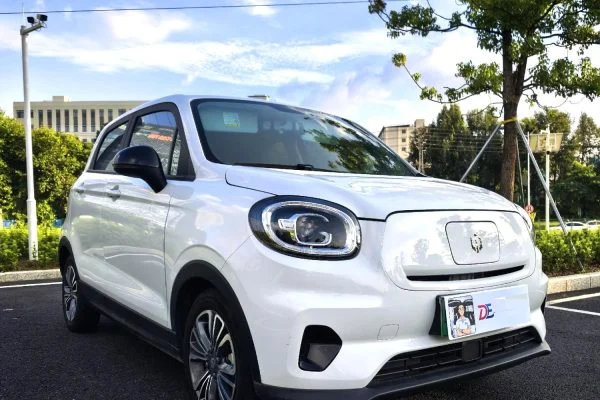
2024 Leapmotor T03 403 Comfort Edition for Sale – 109 hp EV, 403 km Range, Export Ready
- 2024
- 11,000 km
- Automatic
- Electric

2025 Geely Geome Xingyuan 310km Youth Edition (58kW RWD / Flyme Auto) Compact EV
- 2025
- 18,000 km
- Automatic
- Electric