









Cheap Second Hand Electric Cars for Sale: 5 Picks Under $11k

The cheapest second-hand electric cars worth importing from China in 2026 start around $7,200 and top out near $10,800, covering the BYD Seagull, Wuling Bingo, Geely Panda Mini, Changan Lumin and Geely Geome Xingyuan. All five are city cars. None of them will do 400 km on a charge.
That is the honest starting point. The sub-$11k bracket buys you a genuinely usable urban EV with a two-to-four-year-old LFP pack, and it buys you nothing else.
Which cheap second-hand EV gives the most range per dollar?
The BYD Seagull. Its 30.08 kWh Blade pack is rated 305 km CLTC, which is about 240-255 km real-world, and used 2023 examples sell for $7,800-$9,600. Nothing else in the bracket matches that combination.
2023 BYD Seagull Vitality Edition 305km EV sits at the top of the trim ladder with 13,000 km, and 2023 BYD Seagull Free Edition 305km is the same car with more miles and a lower ask. Both take DC fast charging at 30 kW, which sounds slow until you remember the pack is small – 30 minutes gets you from 30% to 80%.
What about the Wuling Bingo and Geely Panda Mini?
The Bingo is the roomiest of the five, with four real doors and a boot that swallows a week of groceries. 2024 Wuling Bingo has 333 km CLTC from a 37.9 kWh pack and 68 hp. Used ask: $8,400-$10,600.
The Geely Panda Mini is the opposite trade. 2025 Geely Panda Mini EV is 210 km CLTC with a 22 kW fast-charge option, and at $6,900-$8,200 it is the cheapest car here. It is also the most limited: 41 hp, a 3-metre body, and no meaningful cargo space behind the rear seats.
Why are these cars so cheap?
China built almost 9 million NEVs in 2025, and a large share went into ride-hailing and short-lease fleets. Those fleets turn cars over at 24-36 months, which floods the domestic used market with low-mileage, small-battery cars that have no export premium.
Depreciation curves confirm it. A Bingo that listed at RMB 59,800 new trades near RMB 38,000-45,000 after two years – a 25-35% drop, steeper than any comparable petrol hatchback.
What rules a cheap EV out for your situation?
Three hard limits, in order of how often they disqualify buyers:
- Charging at home. Without a wallbox or a 220V garage socket, a 200 km car becomes a weekly chore. These cars charge slowly on AC – 6.6 kW at best, often 3.3 kW.
- Motorway use. Most are capped near 100-110 km/h and the small packs drain fast at that speed.
- Parts support. The Seagull and Bingo have export parts channels. The Panda Mini and Lumin are thinner – check before you commit.
Cold climates deserve a fourth line. LFP packs without active heating lose 30-35% range at -10°C, and none of these five ships with a heat pump as standard.
Is it worth buying a second-hand electric car at this price?
If you drive under 60 km a day and can charge at home, yes – the running cost works out to roughly $0.03/km on cheap night tariffs. If you drive 120 km a day, no. You will spend the savings on public fast charging and range anxiety.
One caution on condition: cheap cars attract cosmetic patches. Look for mismatched panel gaps and paint texture differences around the front wings, and insist on a BMS printout. A 2023 Seagull with 25,000 km should read 93% or better state of health.
Key Takeaways
- Sub-$11k Chinese used EVs: Seagull, Bingo, Panda Mini, Lumin, Geome Xingyuan.
- The BYD Seagull offers the best range per dollar – 305 km CLTC, about 240-255 km real.
- Expect 25-35% depreciation in two years on these city cars, which is why they are cheap.
- Home charging and a sub-60 km daily drive are the conditions that make them work.
Related Vehicles
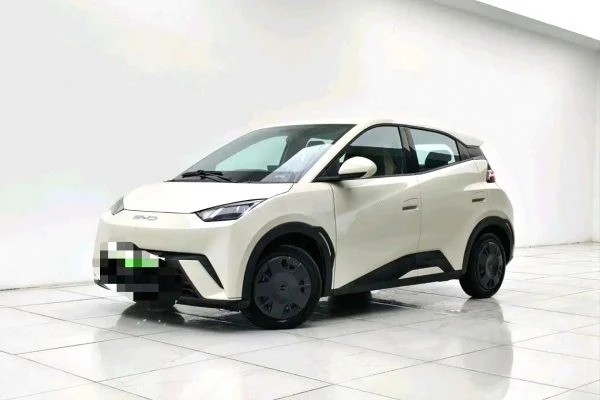
2023 BYD Seagull Vitality Edition 305km EV (75 HP / FWD) – 13,000 km Like-New
- 2024
- 13,000 km
- Automatic
- Electric

2024 Wuling Bingo (Binguo) 333km Enjoy Edition (50kW / 68HP) Electric Hatchback
- 2024
- 60,000 km
- Automatic
- Electric

2024 Wuling Bingo EV 203km Light Edition (30kW FWD / DC Fast Charging) City Hatchback
- 2025
- 4,000 km
- Automatic
- Electric

2025 Geely Geome Xingyuan 310km Youth Edition (58kW RWD / Flyme Auto) Compact EV
- 2025
- 18,000 km
- Automatic
- Electric